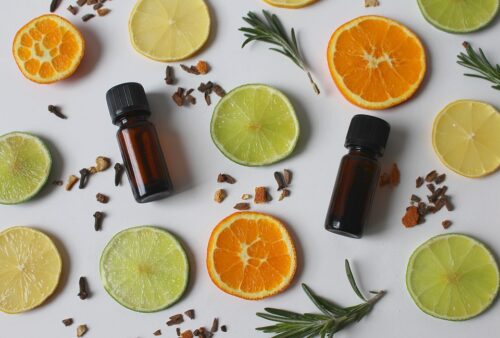
Lemon belongs to the Rutaceae family among other citrus fruits, which is why it is high in vitamin C and other plant compounds like d-limonene and terpenes. It is integral to aromatherapy and a common ingredient in household products.
Uses of Lemon Oil
You can find lemon and other citrus oils in shampoos, detergents, soaps, and air fresheners due to their uplifting and fresh scent and you can also make your own eco-friendly insect and mosquito repellents using oils you have made yourself. Lemon oil may even be used for organic pesticides.
The essential oil from lemons inhibits bacteria and these antibacterial properties can, according to some sources, prevent many diseases, including cancer. When diluted, lemon oil improves sleep quality, increases concentration, alleviates skin diseases, improves mood, and relieves headaches.
Benefits of Lemon Oil
- Lemon oil can relieve dry mouth or xerostomia. It is common among patients with head and neck cancer who undergo radiation therapy. D-limonene is the active compound present in lemons that is responsible for this benefit.
- In a different study, researchers found out that D-limonene has anti-cancer properties.
- Lemon oil has about 94% terpenes that can curb the growth of liver cancer cells.
- It has anti-inflammatory and antioxidant properties.
- Due to its antibacterial properties, lemon oil may also alleviate irritable bowel syndrome (IBS).
- Lemon oil offers lots of benefits for skincare. It helps in skin whitening, treats acne and heals insect bites. (Or at least stops us from clawing our skin off)
The Distillation Process of Lemon Oil
Proper distillation will yield pure lemon oil. There are two feasible distillation processes you can follow: steam distillation and hydrodistillation. Both of these processes require some specialized equipment though, which is worth considering if you have prolific lemon trees and are not quite sure what to do with your many lemons. For an efficient distillation process, use a distillation set such as Copper Alembic or Borosilicate Distillation Set.
The process and procedure are generally the same. If you are thinking of distilling your lemon essential oil, get a head start through the following steps.
- First, you need to grate the lemon peels using a cheese grater or a blender. It is crucial to reduce the particle size of the lemon peel is so that the steam can carry the lemon essential oil out of the mixture.
- Familiarise yourself with your equipment.
- Place the grated lemon peels in a flat-bottomed flask using a funnel.
- Add enough water to fill the flask.
- Stir and make sure that the crushed lemon peels get wet properly.
- Assemble your distillation set by following the instructions on the kit.
- Prepare ice-cold water for your condenser.
Procedure
- Simmer the distilled water. As the water boils the steam passes through the flask that contains the lemon peels.
- Let the steam pull the oils out of the lemon peels for an average of 2 hours for every 4 to 5 ounces of lemon peel.
- Connect the inner tube to a bucket of ice-cold water. The condenser filled with ice-cold water will push the oil through the pipes. The cold water then condenses it and brings it down to the separator.
- The oil accumulates in the separator for you to pour off.
- Store the lemon oil in dark glass bottles
You can also use a copper alembic still for either steam and hydro-distillation. The cost of a still varies from about R3500 to over R8000 but it seems they can be used for alcohol distillation as well. This may be useful. 😊 There are many sources for stills but this one will give you a great overview of what is available.
- Put the lemon peels in the still.
- Pour the hot water on them and let sit for 24 hours.
- Seal the pipes and stills to keep the steam intact.
- Make sure to set up the distillation set and fill up the condenser with cold water.
- Place the alembic on top of a stove or a source of fire and let the water boil.
- The steam contains the essential oil from the mixture and flows through the tubes finally into the container.
Conclusion
You can distill lemon oil at home by following these procedures. For visual instructions, take a look at the YouTube links.
Also, take a look at the following past article on the benefits of lemons.
References:
Benefits:
https://www.sciencedaily.com/releases/2018/05/180521154248.htm
https://www.healthline.com/nutrition/d-limonene
https://www.sciencedaily.com/releases/2015/01/150119082958.htm
https://www.sciencedirect.com/topics/agricultural-and-biological-sciences/lemon-oil
https://www.healthline.com/nutrition/6-lemon-health-benefits
https://www.ncbi.nlm.nih.gov/pmc/articles/PMC4220539/
https://www.healthline.com/nutrition/6-lemon-health-benefits#TOC_TITLE_HDR_6
Distillation
https://www.youtube.com/watch?v=NlgZACkf3Q4
https://www.sciencedirect.com/science/article/abs/pii/S0255270113001529
https://www.youtube.com/watch?v=H7y-yqhUE54